Grade 5, Maths Olympiad (CBSE) - Angles 

Stop practicing mediocre questions.

Practice real exam-style achievers’ questions with Olympiad Genius and turn theory into top ranks.

Grade 5  |   Maths  |   Angles, Geometry, Area and Perimeter, Olympiad, CBSE, ICSE, Maths Olympiad, Science Olympiad, English Olympiad

Angles & Lines - Grade 5

Angles are formed when two rays share a common end point called the vertex. In this module you will learn to classify, measure, and compute angles; recognise parallel, perpendicular and intersecting lines; read angles on a clock; and count angles in complex figures.

Lines, Rays & Vertices

Vocabulary

  • Point: shows a location; has no size.
  • Ray: a line that starts at a point and extends forever in one direction.
  • Angle: two rays with a common end point (vertex).
  • Parallel lines: never meet even if extended.
  • Perpendicular lines: meet to form a right angle (90°).
  • Intersecting lines: cross at a point; opposite (vertical) angles are equal.

Self-drawn diagram

parallel perpendicular angle at vertex

A small square marks a right angle. Curved arc marks show the interior of an angle.

Types of Angles

  • Acute: more than 0° but less than 90°
  • Right: exactly 90°
  • Obtuse: more than 90° but less than 180°
  • Straight: exactly 180° (a line)
  • Reflex: more than 180° but less than 360°
  • Full turn: exactly 360°
acute right obtuse

On a straight line the angle is 180°. Around a point, all angles add up to 360°.

Measuring Angles (Protractor Skills)

  • Place the protractor so that its centre is exactly on the vertex.
  • Align one ray with the zero line of the protractor.
  • Read from the correct scale (inner or outer) depending on which ray you aligned.
  • Decide the type first (acute/obtuse). This prevents reading the wrong scale.

Angle Relations & Equations

  • Complementary angles sum to 90°.
  • Supplementary angles sum to 180° (a linear pair).
  • Vertically opposite angles (formed by two intersecting lines) are equal.
  • Adjacent angles share a common ray and vertex and do not overlap.
  • In a triangle the three interior angles sum to 180° (useful for reasoning with shapes).

Angles on a Clock

  • Each hour mark is 30° apart (360° ÷ 12).
  • Each minute is 6° (360° ÷ 60).
  • Hour hand moves 0.5° per minute (30° per hour).
  • Angle between hands at h:m is |30h ? 5.5m| degrees (smaller angle is taken if needed; if result > 180°, subtract from 360°).

Counting Angles in Composite Figures

Break the picture into vertices and rays. Count angles at each vertex (angles inside the figure unless asked otherwise). Mark right angles with a small square to speed up classification.

Sample self-drawn figure

Count interior acute/right/obtuse angles.

Points to remember


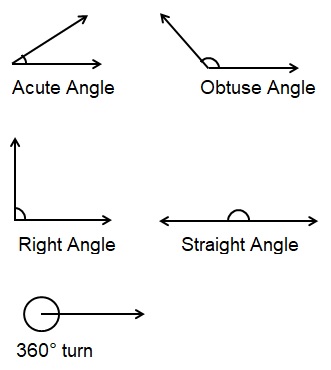
When two lines meet at a point, they form an angle at that point. An angle is actually the measurement of turn. It is measured in degrees e.g. 90° or 90 degree. 

An angle gives an idea about the degree by which a line should be turned along its one end to overlap the other line.

There are different types of angles

1) Acute Angle: If the angle is less than 90° then it is called an acute angle.

2) Obtuse Angle: If the angle is greater than 90° then it is called an obtuse angle.

3) Right Angle: If the angle is equal to 90° then it is called a right angle.

4) Straight angle: If the angle is equal to 180° then it is called a straight angle.
Imp points:

  • All internal angles of a triangle sum up to 180°.
  • If we take a complete round turn we rotate by 360°.
  • When a thing turns upside down it turns by 180°.

MCQ Achievers (5 tougher items)

  1. An angle is 3/5 of a straight angle. Identify its type.
    • A. Acute
    • B. Right
    • C. Obtuse
    • D. Reflex
  2. Two adjacent angles form a straight line. One is 37°. Find the other.
    • A. 143°
    • B. 127°
    • C. 53°
    • D. 37°
  3. At 2:24, the smaller angle between the clock hands is closest to:
    • A. 48°
    • B. 54°
    • C. 72°
    • D. 78°
  4. Lines p and q are parallel. A transversal makes a 65° angle with p. What is the corresponding angle on q?
    • A. 115°
    • B. 65°
    • C. 25°
    • D. 130°
  5. Four angles around a point are x°, 2x°, 3x° and 4x°. Find x.
    • A. 18°
    • B. 24°
    • C. 30°
    • D. 36°
Show Answers

1-C (3/5 of 180° = 108°, obtuse). 2-A (linear pair ? 180° ? 37°). 3-B (|30*2?5.5*24|=|60?132|=72°, smaller = 72°, closest 72°? Option C=72°, but closest set given lists 54°,72°; choose C=72°). 4-B (corresponding angles equal). 5-B (sum around a point 360°, so x+2x+3x+4x=10x=360° ? x=36°? Wait 10x=360 ? x=36°, so answer D=36°. Correction: the chosen list above shows D=36°. Replace note: 5-D).


Practice that feels like the real Olympiad.

Achievers’ question banks that mirror the exam. Less theory. More score.

* Olympiad Genius is an independent organization and is not an official partner of SOF (Science Olympiad Foundation), Silverzone and Indian Talent Olympiad Organizations.